Looks complex?
We handle it.
MTAS runs the OAuth dance, signs RS256 JWTs, rotates refresh tokens and isolates tenants — so your backend just verifies a token and gets on with shipping the product.
Three steps. That's the whole integration.
The SDK handles CSRF, JWKS verify, refresh dedup, cookie crypto. You write zero auth code.
Register your app
Sign up, claim an appId, whitelist your callback URL and frontend domain.
Install the SDK
npm install @davydko-mtas/express cookie-parser
Wire it up
createMtasAuth(config) returns a router + auth middleware. Mount it, and you're done.
Security, baked in.
Nine guarantees the SDK enforces by default. You don't opt in. You can't accidentally opt out.
Tenant Isolation
Each registered app gets its own user pool. Users belong strictly to the tenant that registered them — never shared. The same email can exist under different tenants.
Stateless RS256 + JWKS
JWTs are signed with RS256 (asymmetric). Your backend fetches the public key from a standard JWKS endpoint once, then verifies every token locally — no per-request calls.
Refresh Rotation + Replay Detection
Refresh tokens rotate on every use and are grouped by family. Reusing a rotated token revokes the entire family — aligned with RFC 9700 §4.14.
Login CSRF Defense
Each login flow carries a random state stored in a cookie and validated on callback. Stops attackers from injecting their auth codes into a victim's session.
BFF + Encrypted Session
Tokens never reach the browser. Your backend exchanges the auth code server-to-server, seals both tokens into an HttpOnly iron-session cookie (AES-256-GCM), and refreshes them transparently.
Confidential Client Auth
Token endpoints require Basic base64(appId:appSecret) per RFC 6749 §6. Secrets are SHA-256 hashed at rest, shown once, and rotatable from the dashboard.
Audience-Bound Tokens
Each JWT carries an aud claim tied to your appId. Backends must validate it — a token issued for tenant A is rejected by tenant B.
Token Revocation
Logout calls RFC 7009 /revoke with the refresh token — the entire token family is soft-revoked at MTAS, killing every future refresh attempt.
Redirect URI Whitelist
Login attempts are rejected unless the redirect URI matches the client's whitelist exactly. Prevents open redirect attacks.
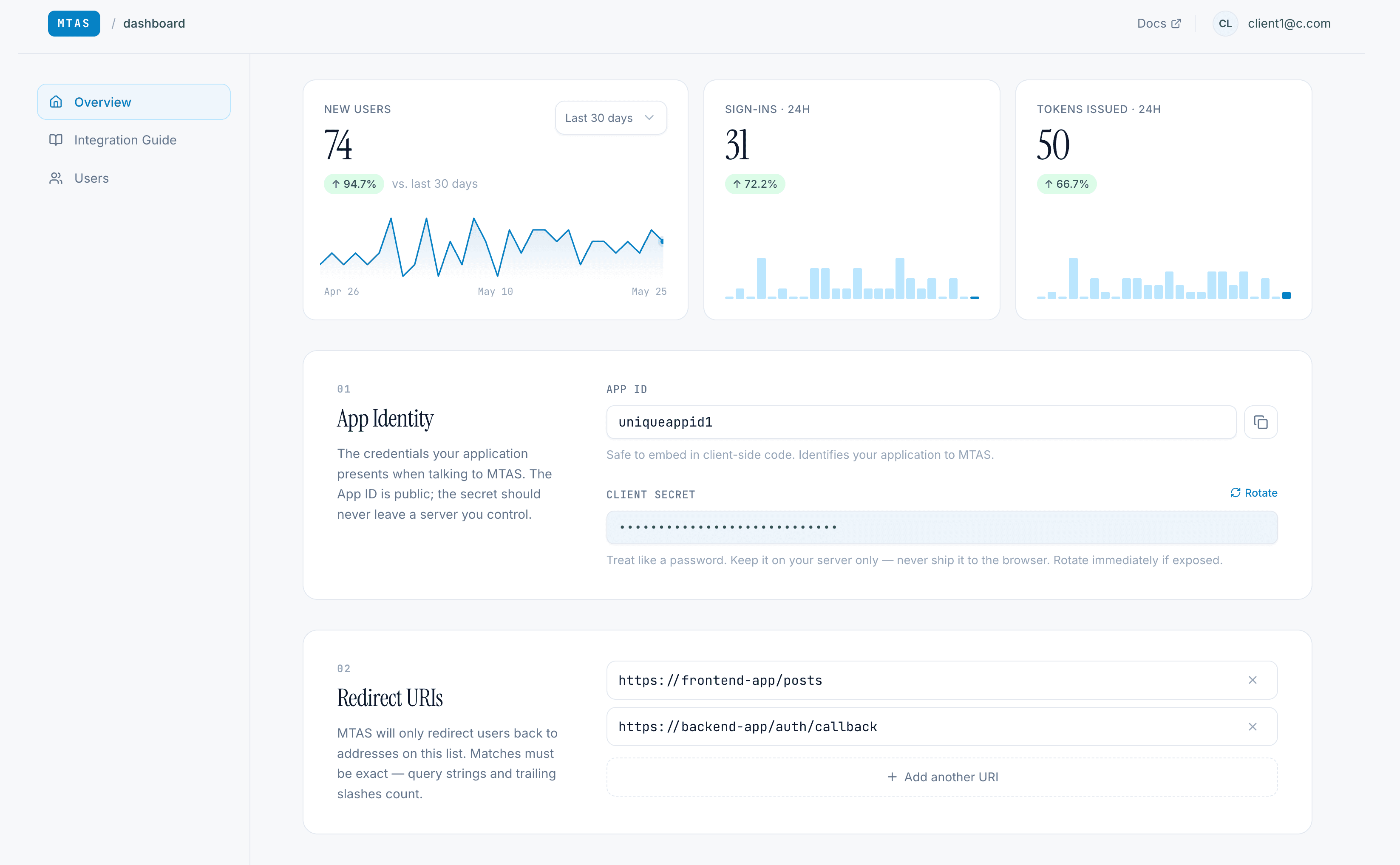
Everything you need, in one dashboard.
Auth analytics. Server-side secrets with one-click rotation. Redirect URIs management.
What's under the hood.
API
Auth broker- NestJS 11 + TypeORM
- JWT (RS256 / HS256)
- PostgreSQL
- Passport.js
UI
Dashboard- Next.js 15 + React 19
- shadcn/ui + Tailwind CSS
- React Hook Form + Zod
- TanStack Query
Custom SDK
@davydko-mtas/express- @davydko-mtas/express on npm
- TypeScript + tsup (ESM/CJS/dts)
- Drop-in createMtasAuth(config)
- Handles CSRF, JWKS verify, refresh dedup, cookie crypto
Infrastructure
Deploy- Docker Compose (local PostgreSQL)
- Coolify (production)
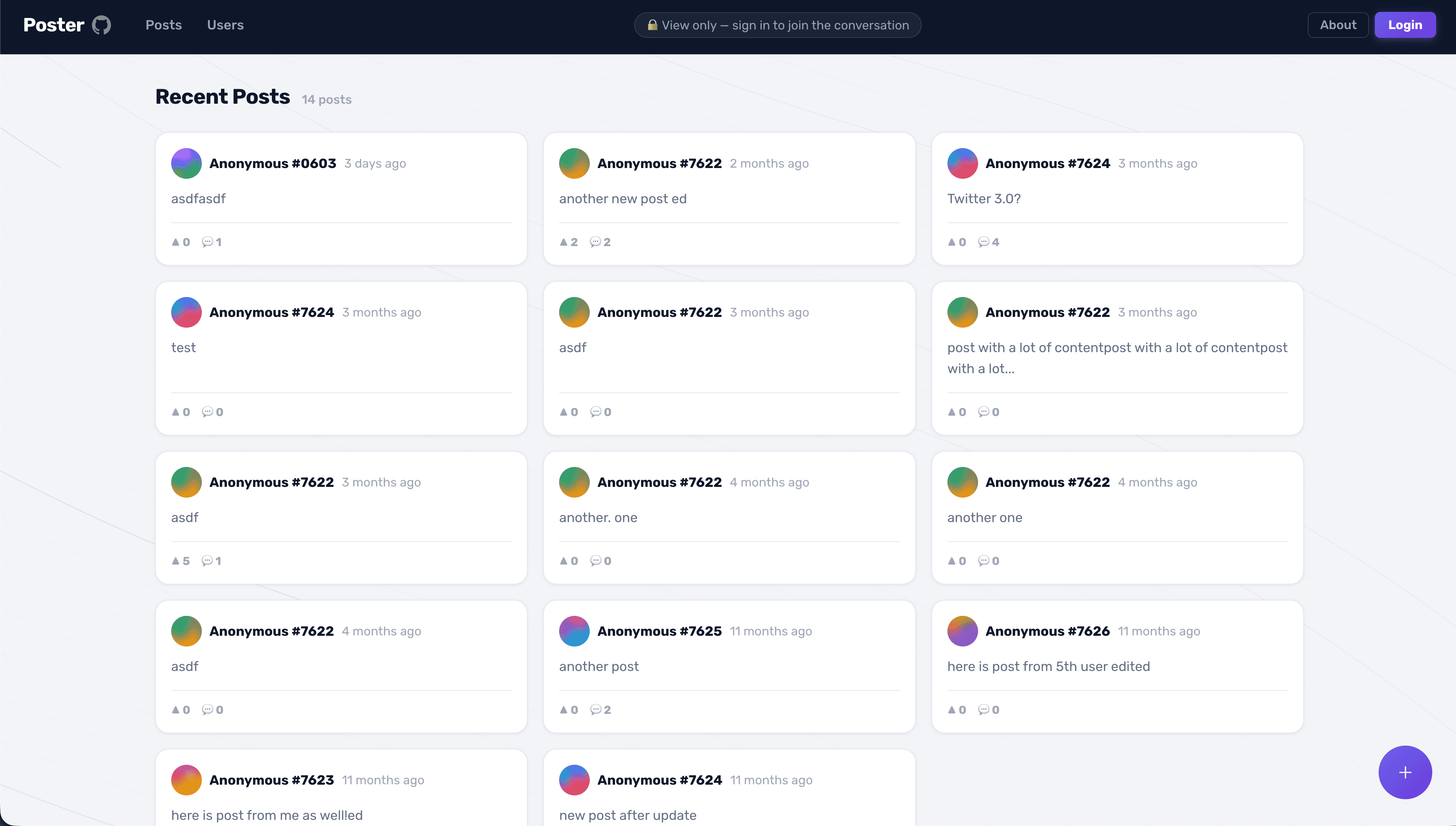
See MTAS in production.
Poster — a community feed app — runs its entire authentication flow through MTAS. Login, session, refresh and logout all go through the same multi-tenant broker described on this page.
Outsource the auth. Keep the product.
Register a client account, configure redirect URIs, and your users are signing in against an isolated tenant in under an hour.